

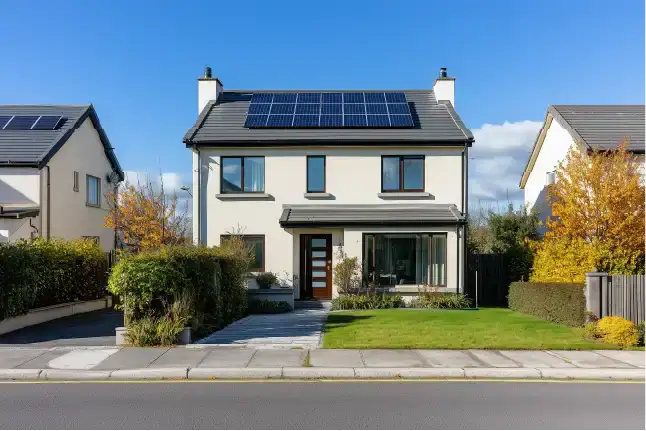
On my regular five-minute walk to the local Centra last week, I noticed a neighbour’s roof gleaming with newly installed solar panels. It wasn’t something I’d seen on that street before, and it got me paying attention. Slate, tile, flat extensions – every roof I passed looked a little different, with no two houses quite the same.
It got me thinking: when roofs vary this much across Ireland, does it actually matter what type you have when it comes to installing solar panels?
The short answer is yes – but maybe not in the way most people expect.
Do Solar Panels Work on All Roof Types in Ireland?
In most cases, solar panels can be installed on a wide range of roof types across Ireland.
What matters isn’t just the material of the roof, but a combination of factors including orientation, available space, structural condition and shading.
That said, some roof types are easier to work with than others, and may influence installation methods, cost or overall system design.
In practice, experienced installers will assess all of these factors before recommending a system. At Activ8 Solar Energies, this typically forms the starting point of any solar design, ensuring the system is built around the home rather than just the roof.
Solar Panels on Tiled Roofs
Concrete and clay tiled roofs are among the most common in Ireland and are generally very well suited to solar panel installation.
Panels are typically mounted using brackets that sit beneath the tiles and attach securely to the roof structure. Once installed, the panels sit slightly above the roof surface, allowing for airflow and efficient performance.
Because tiled roofs are so common, installation methods are well established and relatively straightforward.
Solar Panels on Slate Roofs
Slate roofs are also common, particularly in older properties.
While solar panels can absolutely be installed on slate roofs, the process tends to be more careful and labour-intensive. Individual slates may need to be removed and replaced during installation to ensure a secure and weatherproof fit.
This doesn’t prevent solar installation, but it can slightly increase installation time and cost compared to tiled roofs. Most installations are completed within one day, but a longer installation may be required if a roof is complex, steep or difficult to access.
Flat Roof Solar Panels in Ireland
Flat roofs are often found on extensions, commercial buildings and some modern homes.
Instead of mounting panels directly onto the roof surface, flat roof systems typically use angled frames to position panels at an optimal tilt.
This allows installers to maximise exposure to daylight and adjust panel angles for better performance. In some cases, it can also avoid the need for roof penetrations altogether.
Flat roofs can be an excellent option for solar, particularly where there is a large, unobstructed surface area.
Does Roof Direction Matter More Than Roof Type?
While roof type is important, orientation often has a bigger impact on performance.
South-facing roofs generally produce the most electricity, but east–west systems are also very effective and are commonly used across Ireland.
Even roofs that aren’t perfectly positioned can still generate meaningful amounts of electricity when systems are designed correctly.
In most cases, roof direction and shading will have a greater influence on performance than the material of the roof itself. This is something Activ8 Energies takes into account when designing systems for Irish homes.
What About Older Irish Homes?
Many homeowners assume that solar panels are only suitable for newer houses, but that’s not the case.
Older homes with slate roofs, dormer layouts or less conventional designs can still be strong candidates for solar.
The key consideration is the structural condition of the roof. If the roof is in good condition and has sufficient space, solar panels can usually be installed successfully.
In some cases, homeowners choose to combine solar installation with roof upgrades or broader energy improvements.
Common Concerns About Roof Suitability
It’s normal for homeowners to have questions about whether their roof is suitable for solar panels.
Some of the most common concerns include:
- Will panels damage the roof?
- Is my roof strong enough?
- Will it look out of place?
In reality, modern solar systems are designed to integrate safely with existing roof structures. When installed correctly, they should not cause damage and are built to withstand Irish weather conditions.
The Importance of Proper System Design
The most important factor in any solar installation isn’t the roof type alone – it’s the overall system design.
A well-designed system takes into account factors such as roof orientation, shading, electricity usage patterns, available space and long-term performance.
This ensures the system is tailored to the home rather than simply fitted to the roof.
Thinking About Solar Panels for Your Roof?
If you’re considering solar panels, the best way to understand what works for your home is to have it properly assessed.
Whether your home has traditional slate, standard tiles or a modern flat roof, solar panels can be fitted effectively when the system is designed. The key is tailoring the setup to your home’s layout, electricity usage and available supports like SEAI grants.
Activ8 Solar Energies has delivered more than 25,000 energy upgrades across Ireland, working with a wide range of roof types – from modern tiled homes to older slate properties.
Once you understand what’s possible, solar panels become far less about the type of roof you have – and more about how your home uses energy.