
The UK Minister for Aviation, Maritime and Decarbonisation, Keir Mather MP, today officially opened Liverpool John Lennon Airport’s (LJLA) new £3m solar farm during a visit to the airport.
The airport’s investment in the solar farm is a key part of its Decarbonisation Plan and a zero carbon future for the airport operation by 2040.
Activ8 Energies in partnership with SSE Airtricity and supported by our UK division, designed and installed the new solar farm, which is located within the airport perimeter fence on land to the east of the runway. It is capable of generating up to 3 MW (megawatts) of electricity, powering up to 25% of the airport’s current overall electricity demand.
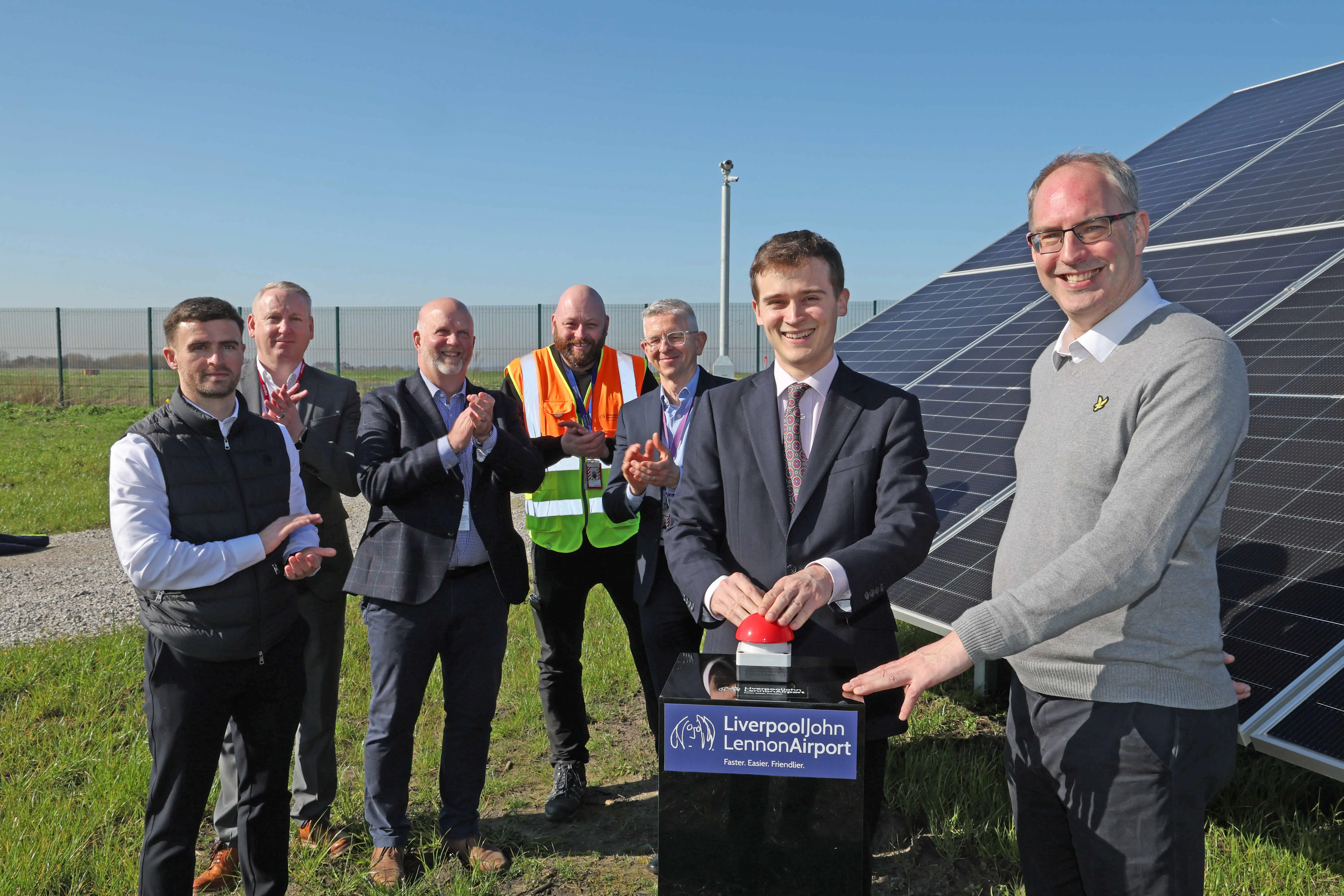
The Minister opened the solar farm as part of a wider visit to also find out about the airport’s recovery since the pandemic, with 2025 being the airport’s busiest year ever.
Ciaran Marron, CEO of Activ8 Energies, commented, “We’re proud to have partnered with SSE Airtricity and Liverpool John Lennon Airport to deliver a system that will generate clean electricity on site for decades to come. This project also marks an important step in Activ8’s continued expansion in the UK, bringing our proven delivery capability to large-scale infrastructure projects.”
Benedict Ennis, Managing Director of Activ8 Energies UK, said, “This project is a direct result of the investment we’ve made in building and scaling our UK operation. It has given us the capability to deliver projects of this scale while supporting businesses across the UK in reducing energy costs and accelerating their transition to renewable power. Combined with Activ8’s proven track record, we are well positioned for continued growth, with a strong pipeline of projects already in development.”
John Irving, CEO Liverpool John Lennon Airport, added, “We really appreciate The Minister taking the time to meet with us today to see at first hand our recent progress and our commitment to minimising energy use and how we are working to reduce our CO2 emissions. Our new solar farm is the next part of our journey towards a zero carbon future by 2040.”
Click the button to return to our blog