
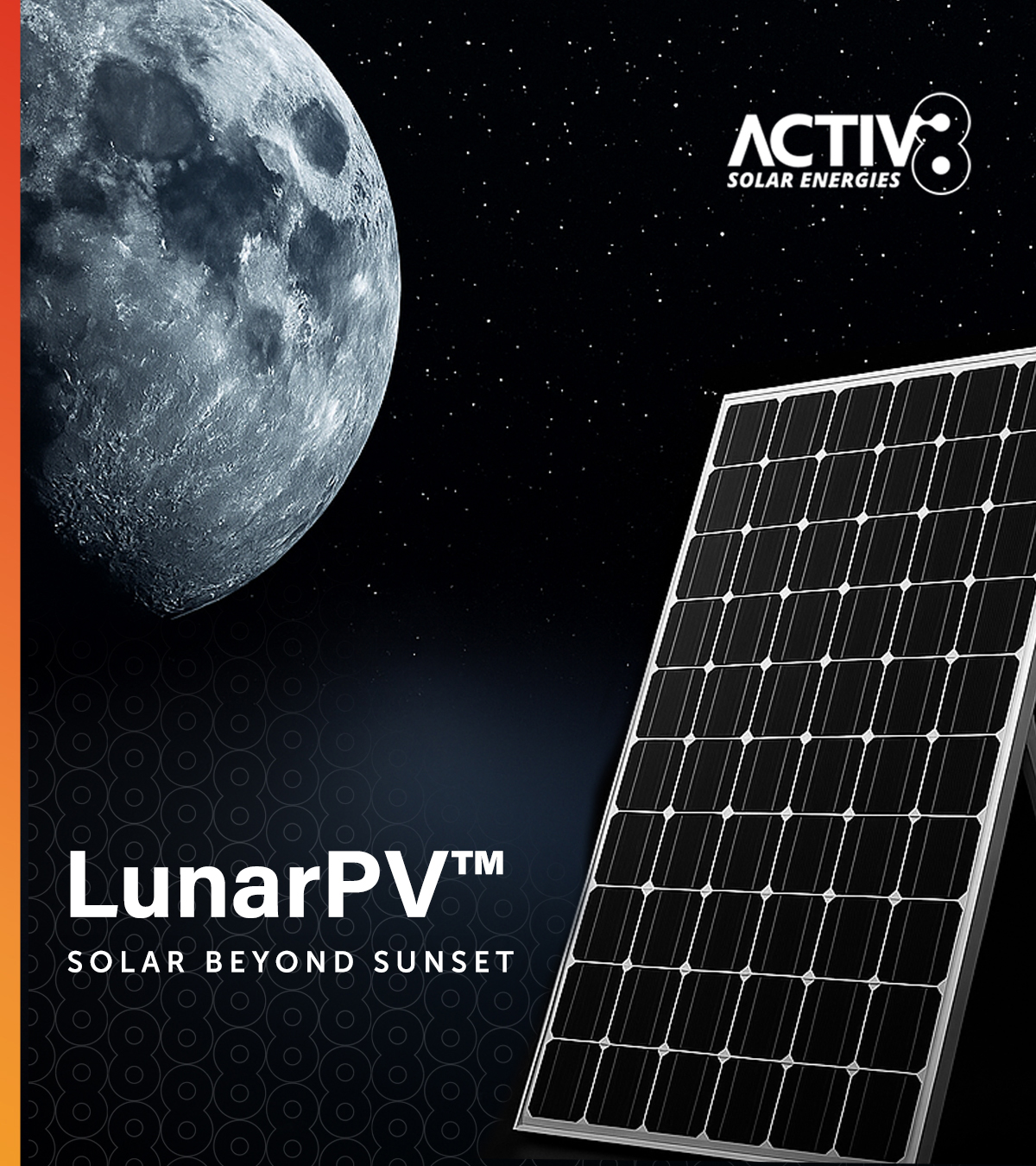
Activ8 Energies has today announced the launch of LunarPV™, an innovative solar PV module designed to generate electricity both during the day and after sunset, marking a significant step forward in solar technology.
Traditionally, solar panels rely exclusively on sunlight, with energy production stopping once daylight fades. LunarPV™ challenges this limitation by integrating advanced thermodynamic and radiative technology, enabling the module to continue generating power at night.
By harnessing the natural process of radiative cooling — where heat is emitted from the Earth’s surface into the night sky — LunarPV™ creates a temperature differential that can be converted into usable electricity. This dual-mode capability allows the system to operate beyond daylight hours, extending the overall energy generation window.
Myles Knight, Chief Lunar Officer of Activ8 Energies said:
“LunarPV™ represents a fundamental shift in how we think about solar energy. For decades, solar has been limited to daylight hours. Based on APRIL Technology (Advanced Photonic Radiative Interface Layer), with LunarPV™, we’re demonstrating that energy generation doesn’t have to stop when the sun goes down. This is about maximising every opportunity to generate clean power and pushing the boundaries of what solar can deliver.”
The new module operates in two distinct modes — delivering high-efficiency photovoltaic performance during the day, while activating its thermoradiative functionality at night to capture energy from heat loss to the atmosphere.
This innovation has the potential to improve overall system yield, reduce reliance on battery storage, and better align energy generation with real-world demand patterns, particularly during evening hours.
LunarPV™ builds on Activ8 Energies’ established track record of delivering high-performance solar solutions across residential and commercial markets, including large-scale projects and proprietary panel development tailored to local conditions.
The company expects LunarPV™ to form part of its future product roadmap as solar technology continues to evolve toward more continuous, round-the-clock energy generation.
Click the button to return to our blog